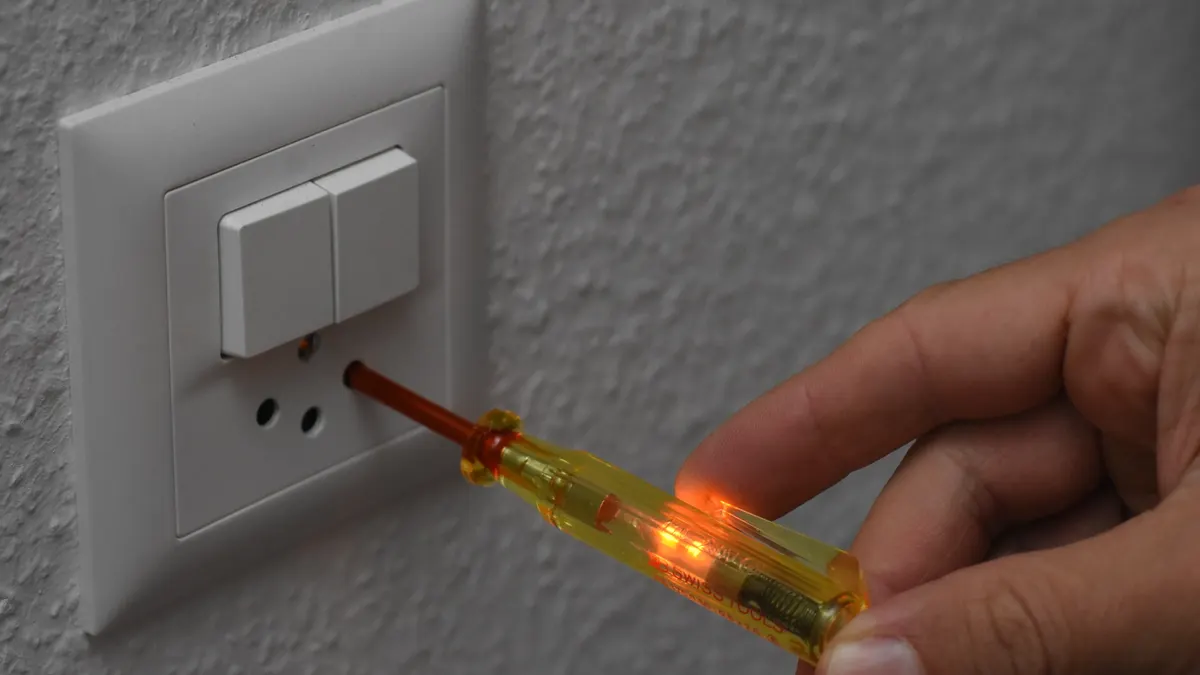
A tespen is a small screwdriver with an indicator lamp in its handle. This simple tool helps you find out whether a point is live, such as a socket hole, a wire end, or a lamp holder. Almost every home, small workshop, and shop that often changes bulbs keeps one. For the result to be trustworthy and the user to stay safe, understand how it works and its limits.
How a voltage tester works
Inside a tespen is a small neon lamp and a very high-value resistor. When the metal tip touches a live wire and your finger touches the metal part at the end of the handle, a very tiny current flows through the lamp and your body to earth, so the lamp lights up. The resistor limits this current so it cannot be felt. That is why a tespen only works when your finger touches the metal contact at the end of the handle. If the wire touched is neutral or not live, the lamp does not light.
Before you start: check your tester
- Make sure the tester body is not cracked, the plastic handle is intact, and it is not wet.
- Test the tespen on a point you know for sure is live, such as the live hole of a socket in use. If the lamp lights, the tester works.
- Keep your hands and feet dry. Wear rubber-soled footwear if possible.
- Do not use a tespen whose lamp is faint and unclear, or one that has been dropped hard and cracked.
Steps to check a socket
- Hold the tespen by the plastic handle. Your index finger touches the metal contact at the end of the handle. Do not touch the metal shaft.
- Insert the tespen tip into one of the socket holes.
- Watch the lamp. If it lights, that hole is connected to the live wire.
- Move to the other hole. In normal wiring, the neutral hole does not make the lamp light.
- If both holes light or neither lights while the house has power, there may be a wiring fault. Have an electrician check it.
A tespen is also useful to check whether a light switch cuts the live wire. With the switch off, touch the tespen to the lamp holder contact. When installed correctly, the holder contact is not live when the switch is off. If the tester still lights, the switch is probably wired on the neutral. This leaves the holder live even when the lamp is off, which is dangerous when changing a bulb. Ask an electrician to correct it.
Making sure power is off before working
Before replacing a lamp holder, switch, or socket, turn off the MCB (circuit breaker) that feeds that part. Then use the tespen to check all wires at the work point. After that, test the tespen again on another live point to make sure it is not broken. This test, check, retest sequence reduces the risk of a false reading from a dead tester.
Limits of a voltage tester you should know
- A tespen is only a first indication, not a measuring instrument. It does not show the voltage level or the quality of a connection.
- Results can be wrong if your hands are very dry, you are wearing gloves, or you are standing on a very well insulated floor. The lamp may not light even when voltage is present.
- In very bright surroundings, the neon glow can be hard to see. Shade it with your hand or check in a shaded spot.
- A tespen is designed for low-voltage household electricity. Do not use it on high-voltage lines or PLN (state electricity company) equipment.
- The tespen shaft is thin and not designed to undo stiff screws. Use a regular screwdriver for heavy work.
Store the tespen separately from ordinary screwdrivers so they are not mixed up, and label your toolbox. After use, clean dust and rust off the tip with a dry cloth. If the indicator lamp no longer lights when tested on a point that is definitely live, replace the tespen with a new one; do not keep using it.
Safety rules
Never touch the metal shaft or the tip of the tespen while testing. Do not work on wiring in the rain, when the floor is wet, or when you are sweating heavily. If you are unsure of the result or find scorched wires, a burning smell, or sparks, stop work and call a competent electrician. Faults on the meter side and the main PLN MCB are PLN's responsibility; report them through PLN Mobile or the 123 contact center.
FAQ
Why does the tespen not light even though there is power?
Your finger may not be touching the metal contact at the end of the handle, the tester may be broken, or you may be touching the neutral wire. Test the tespen on a point that is definitely live to confirm.
Is it safe to hold the tespen while the lamp is lit?
It is safe as long as you only touch the contact at the end of the handle and not the metal shaft. The resistor inside limits the current to a very small amount.
Is a tespen enough to confirm the power is off?
A tespen helps, but it is not a measuring instrument. Switch off the MCB, check with the tespen, then retest the tespen on a live point. If in doubt, ask an electrician to use the proper meter.