Before plastering a wall, many homeowners are unsure how many bags of cement and sacks of sand to buy. Buy too little and the work stalls; buy too much and the cement goes lumpy from sitting too long. The good news is that plaster materials can be estimated with simple arithmetic using the wall area and the material needed per square meter. This guide gives estimates, not exact figures, because real results depend on how even the wall is, the quality of the sand, and the builder's habits.
Plaster and skim coat: what is the difference?
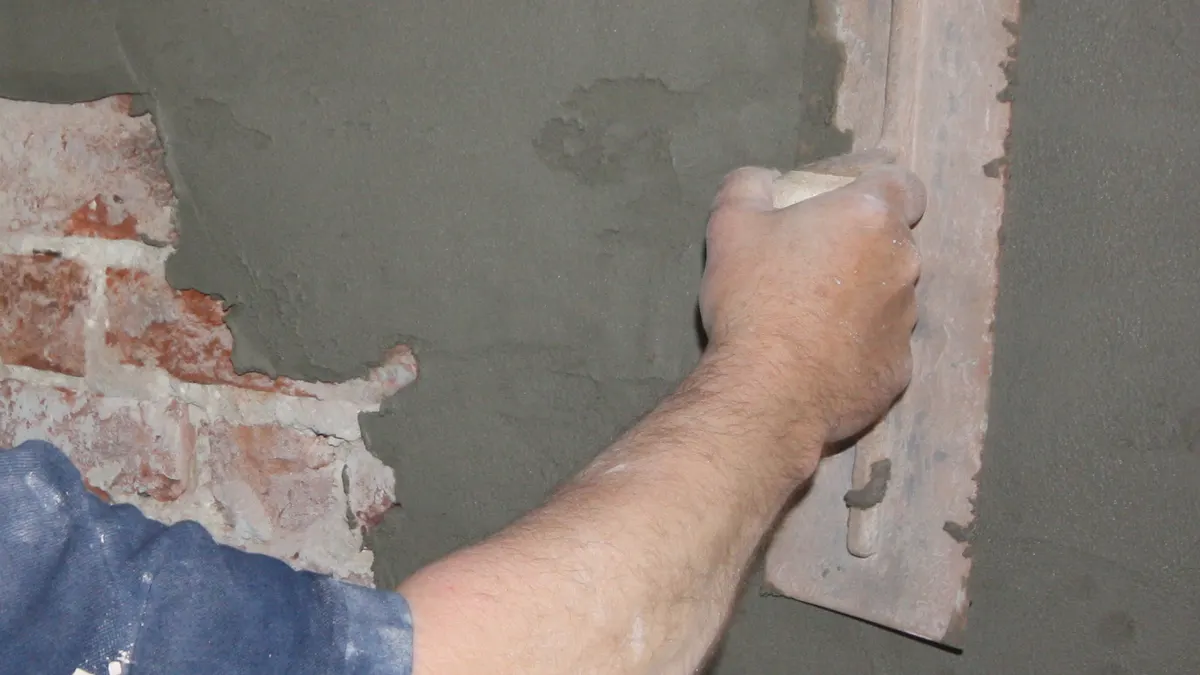
Plaster (plester) is a layer of cement and sand mortar that covers the brickwork so the wall is flat and protected. It is usually about 10 to 15 mm thick. Skim coat (acian) is a thin layer over the plaster that makes the surface smooth and dense before painting. Skim coat can be made from cement and water, or from a ready-mixed skim coat product. Because their thickness and ingredients differ, materials for the two are calculated separately.
Plaster materials per square meter
The figures below are taken from the SNI 2837:2008 unit cost analysis as summarized by cement manufacturers, for 15 mm thick plaster per square meter of wall:
- 1 cement : 4 sand mix: about 6.24 kg of cement and 0.024 cubic meters of sand.
- 1 cement : 5 sand mix: about 5.18 kg of cement and 0.026 cubic meters of sand.
- 1 cement : 6 sand mix: about 4.42 kg of cement and 0.027 cubic meters of sand.
Stronger mixes such as 1:4 or 1:3 are usually chosen for wet areas, for example the lower part of bathroom walls and exterior walls that often get rain. A 1:5 or 1:6 mix is common for dry interior walls. If the plaster is thinner than 15 mm, the materials needed drop roughly in proportion to the thickness.
Related products in storeCheck the latest price and stock from this article. See productsSteps to calculate plaster materials
- Measure the length and height of each wall surface, then multiply them to get the area.
- Subtract the area of doors, windows, and vents.
- Multiply by two if both sides of the wall will be plastered.
- Multiply the total area by the cement and sand figures for the chosen mix.
- Divide the cement needed by the bag size (40 kg or 50 kg) and round up.
- Add a margin of about 5 to 10 percent for spilled mortar and uneven walls.
Example: one side of a wall measures 4 meters by 3 meters, an area of 12 square meters. It has one door of 0.9 by 2.1 meters, or about 1.9 square meters, so the area to plaster is about 10 square meters. With a 1:4 mix, cement needed is roughly 10 times 6.24 kg, or 62.4 kg, equal to about 1.6 bags of 40 kg or 1.25 bags of 50 kg. Sand needed is about 10 times 0.024, or 0.24 cubic meters. After adding a margin, prepare 2 bags of 40 kg cement or 2 bags of 50 kg, and a little over 0.25 cubic meters of sand.
Sand is often sold by the sack or by the cubic meter. The volume of a sack varies between sellers, so ask or estimate the volume of one sack before working out how many sacks you need.
Estimating skim coat
Skim coat is much thinner, usually only a few millimeters, so far less material is needed than for plaster. For ready-mixed skim coat, the most accurate approach is to use the coverage from the product's data sheet. As an illustration, one ready-mixed skim coat product states coverage of about 20 square meters per 40 kg bag at 1.5 mm thickness, or roughly 2 kg per square meter, noting that this depends heavily on the surface condition. For homemade cement-and-water skim coat, ask your builder for an estimate, since every builder's consistency and thickness differ.
Tips so your estimate does not miss
- Use the same measuring container for cement and sand, such as a concrete bucket, so the mix ratio stays consistent.
- Use clean, sieved sand for plaster; muddy sand makes plaster crack easily.
- Wet the brick wall before plastering so the water in the mortar is not absorbed too quickly.
- Buy cement in stages if the job will take a long time, so stock does not go lumpy.
- Keep the plaster damp for the first few days, especially in hot weather.
By measuring the wall area, choosing a suitable mix, and adding a small margin, you can buy just enough plaster and skim coat materials. You can check prices for cement, sand, concrete buckets, and shovels at Anakjuragan.
FAQ
How many bags of cement do I need to plaster 10 square meters?
With a 1:4 mix and 15 mm thickness, you need about 62 kg of cement, or roughly 1.6 bags of 40 kg. After adding a margin, prepare about 2 bags. This is an estimate and may vary with how even the wall is.
Which plaster mix is best for a bathroom?
Wet areas usually use a stronger mix such as 1:3 or 1:4 so the plaster is denser against water. Dry interior walls are generally fine with 1:5 or 1:6.
Does skim coat have to use ready-mixed cement?
No. Skim coat can be made from cement and water, but ready-mixed skim coat is more practical because the proportions are uniform and the coverage is printed on the bag, making it easier to calculate how much you need.