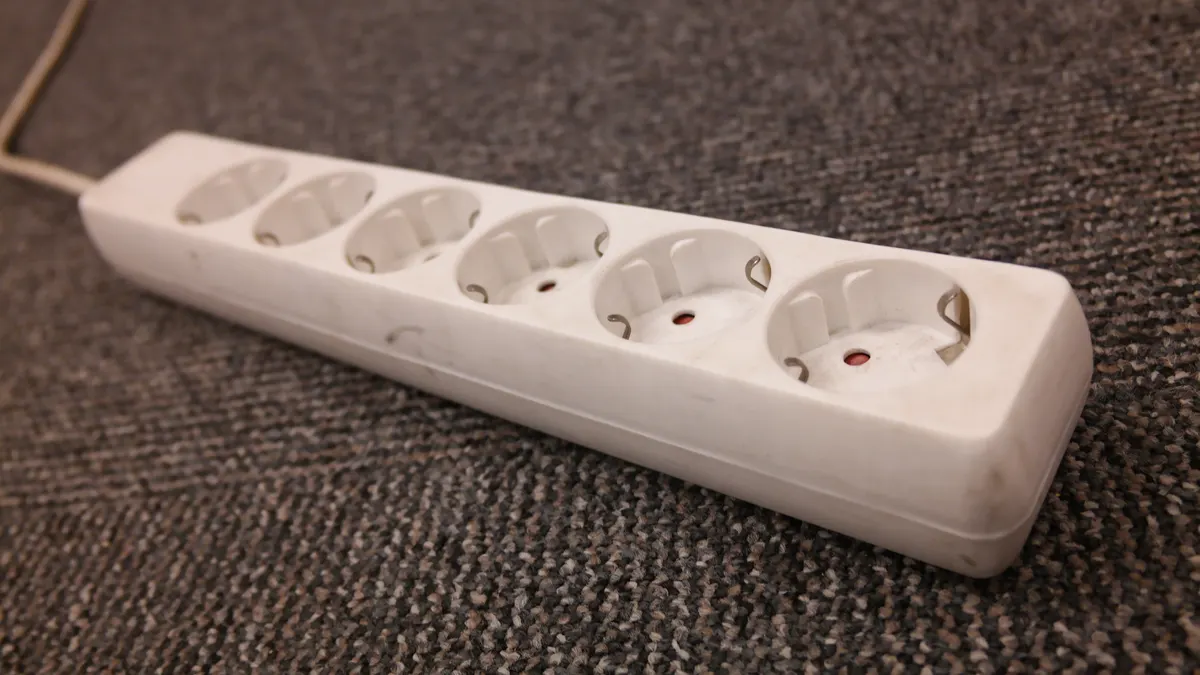
A power strip, or extension socket, is a quick fix when there are not enough wall outlets. At home it is used for the television and chargers; in a shop, for display lights and fans. The problem is that because it is so easy to use, a power strip is often crammed with too many appliances. Overloading makes cables and sockets hot, can melt them, and can even start a fire. Here is how to use a power strip safely.
Know your power strip's capacity
Every power strip has a current and voltage limit, usually printed on its body or packaging, for example 10 A 250 V or 16 A 250 V. The number of sockets does not mean every socket can take a high-power appliance at the same time. What matters is the total power of the appliances running at once.
A simple way to calculate: add up the power (watts) of all appliances plugged into the strip, then compare it with its capacity. As a rough guide on 220 volt electricity, a 10 ampere strip is equivalent to about 2,200 watts. Keep usage well below that figure, and remember that household power is also limited by the MCB (circuit breaker) and your PLN (state electricity company) subscription.
Appliances that should go straight into a wall outlet
An article on the website of the Directorate General of Advanced Health Services at the Ministry of Health reminds readers that high-power appliances, above roughly 250 watts, should use SNI-certified (Indonesian National Standard) cables, sockets, and plugs, and should not be connected through splitters or extension cables. Examples:
- Irons, rice cookers, and water heaters.
- Refrigerators, freezers, and dispensers with heaters.
- Air conditioners, washing machines, and water pumps.
- Electric stoves, ovens, microwaves, and hair dryers.
Power strips are better suited to low-power devices such as phone chargers, desk lamps, small fans, WiFi routers, and televisions.
A simple calculation example: a television of about 100 watts, a 10 watt router, two phone chargers of 20 watts each, and a 40 watt desk fan. The total is about 190 watts, still light for a 10 ampere strip. Compare that with plugging in an iron, which can draw hundreds of watts, together with a rice cooker on the same strip: the load jumps and the strip cable quickly heats up. The exact wattage of each appliance can be found on the label on its body.
Related products in storeCheck the latest price and stock from this article. See productsSafety rules for using a power strip
- Do not daisy-chain one power strip into another. This is a quick way to overload.
- Do not stack plugs with multi-way adapters on top of the strip.
- Uncoil the strip's cable; do not keep it rolled or tied while powering a sizable load, because heat cannot escape.
- Do not run the cable under carpets, mattresses, or places that are often stepped on or rolled over by chairs.
- Keep it away from water, bathrooms, sinks, and areas that easily get wet.
- Place it out of children's reach, or use safety covers.
- Use the strip's switch to turn appliances off when not in use, and unplug the strip when leaving home for a long time.
Warning signs you must not ignore
- The strip, plug, or cable feels warm or hot to the touch.
- A smell of burning plastic, a hissing sound, or sparks when a plug is inserted.
- The strip's plastic is discolored, blackened, or melted.
- Plugs are loose and fall out easily, or the cable insulation is peeling.
- The household MCB trips often whenever several appliances are switched on together.
If any of these signs appear, turn off the appliances, unplug the strip from the wall outlet if it is safe to do so, and do not use it again. Replace it with a new strip. If the wall outlet is the problem, have an electrician inspect the wiring.
Power strips also wear out. The metal clips inside the sockets loosen over time, so plugs are no longer gripped tightly. A loose connection generates heat even with a small load. If plugs wobble or fall out on their own, it is time to replace the strip.
Choosing a good power strip
- Choose a product that carries the SNI mark and a clear current rating.
- The sockets should feel tight when a plug is inserted, not loose or wobbly.
- The cable should be thick enough and its length suited to your needs, not excessive.
- For appliances with a metal body, choose a strip with an earth contact and plug it into a wall outlet that is also earthed.
- A strip with a switch makes it easy to cut power to everything at once.
FAQ
Can a rice cooker and a dispenser share the same power strip?
Better not. Both use high-power heaters. Plug each one directly into a separate wall outlet.
Does a 6-socket strip mean it is safe for 6 appliances?
Not necessarily. What matters is the total power of appliances running at once compared with the strip's ampere rating, not the number of sockets.
Why should a power strip cable not be coiled while in use?
A coiled cable has trouble releasing heat. Under a sizable load, heat can build up and damage the cable insulation.