Putting up a shelf, hanging a picture frame, fixing a door hinge, or making a simple wooden box does not always require calling a handyman. With a few basic tools, many minor repairs can be done yourself. These tools are also useful for shop owners who often build or fix display shelves. Here is a list of tools worth having at home, what they do, and how to use them safely.
Claw hammer
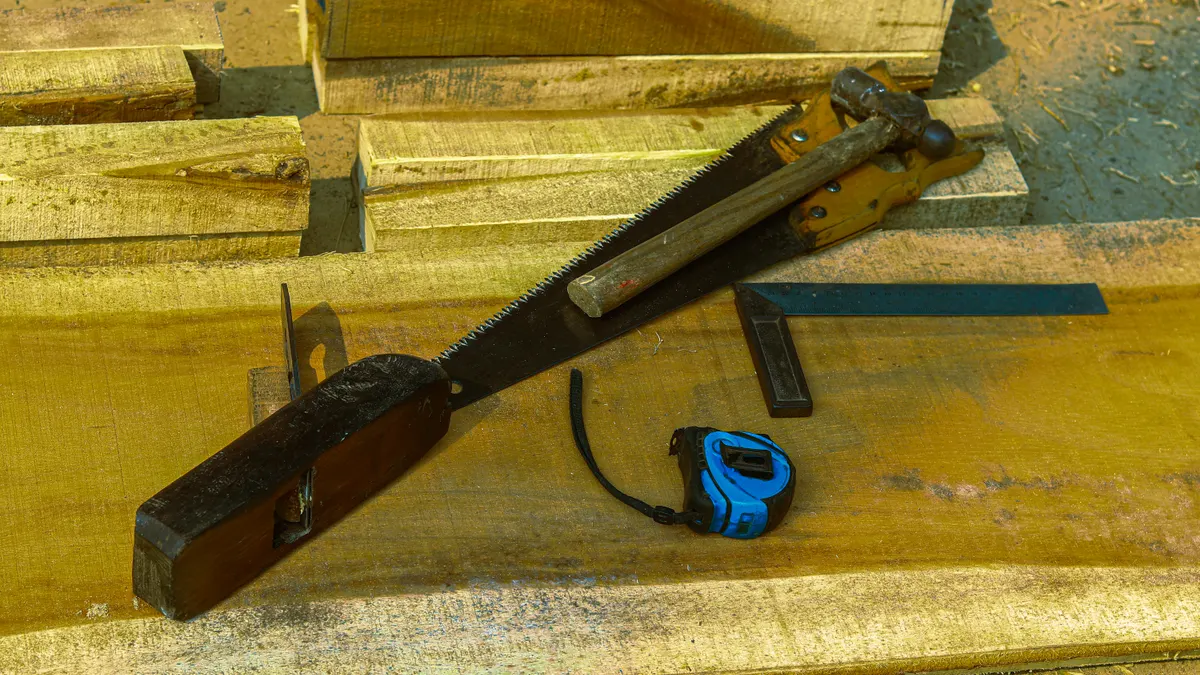
A claw hammer has two ends: a flat striking face for driving nails, and a curved, split claw for pulling them out. A 16 ounce size, such as the Palu Kambing 16 oz, is versatile enough for household jobs.
- Hold the handle near the end, not close to the head, so your swing is more powerful and controlled.
- Start with light taps until the nail stands on its own, then strike harder.
- To pull a nail, slip it into the gap in the claw and lever it out. Put a thin piece of wood underneath so the surface does not dent.
Masonry nails and wood nails: do not mix them up
Wood nails are made from relatively soft steel, suitable for timber, boards, and plywood. Forced into a masonry wall, a wood nail bends easily. Masonry nails are made harder so they can penetrate plastered brick walls or lightweight concrete. But because they are hard, masonry nails tend to be brittle and can snap or fly off if struck at an angle.
- Use wood nails to join timber and plywood. Ideally the nail should be about two to three times as long as the thickness of the board being nailed.
- Use masonry nails to hang light items on masonry walls, and strike them straight.
- For heavy loads such as a fully loaded shelf or wall cabinet, use a drill with wall plugs and screws, not nails.
- Avoid nailing into walls along electrical cable and water pipe routes, for example directly above or below sockets and switches.
Wood saw
An 18 inch wood saw is enough for cutting boards, battens, and plywood. Mark the cutting line with a pencil and a square, then start with a few slow pull strokes so the blade makes a groove. After that, saw at an angle of about 45 degrees to the board and let the teeth do the work rather than pressing hard. Support both sides of the board so the offcut does not snap at the end.
Tape measure and spirit level
A 5 meter tape measure is used to measure length, width, and height. The hook at the end is deliberately a little loose. This small movement compensates for the thickness of the hook itself, so the measurement stays accurate whether the hook is caught on the edge of an object or pushed against a wall. The old rule still applies: measure twice, cut once.
A spirit level is used to make sure something is truly level or plumb, such as a wall shelf, a frame, or tiles. Place the level on the surface and look at the air bubble. If the bubble sits exactly in the middle between the two lines, the surface is level. To check plumb, use the cross vial. A 60 cm spirit level suits shelves and small to medium surfaces.
Combination pliers
8 inch combination pliers have serrated jaws for gripping and twisting, plus a cutting section for wire. They can be used to pull small nails, twist tie wire, cut wire, and hold small nuts. Do not use pliers for hammering or in place of a spanner, because the jaws can be damaged and the nut can get rounded off.
For electrical work, ordinary pliers do not guarantee protection from shock, even if the handles are rubber coated. Switch off the MCB (circuit breaker) before touching wires, and leave electrical installation to an experienced technician.
Caring for and storing tools
- Keep tools in a dry box or on a wall rack so they do not rust and are easy to find.
- Wipe steel tools after use, especially if they get cement mortar or water on them.
- Cover the saw blade with a guard or cardboard so it does not cause injuries.
- Store nails separately by type and size.
- Keep tools up high or locked away if there are small children at home.
A hammer, saw, tape measure, spirit level, nails, and combination pliers are enough for many minor repairs at home and in the shop. Check the latest prices for these basic tools at Anakjuragan.
FAQ
What is the difference between masonry nails and wood nails?
Wood nails are softer and suit timber and plywood. Masonry nails are harder so they can penetrate masonry walls, but they are more brittle and can snap if struck at an angle. Do not use wood nails on masonry walls.
Why does the hook on my tape measure feel loose?
It is intentional. The hook's small sliding movement compensates for its own thickness, so the measurement stays accurate whether the hook is caught on an edge or pushed against a surface.
How do I read a spirit level?
Place the level on the surface you are checking. If the bubble sits exactly in the middle between the two marker lines, the surface is level or plumb according to the vial you are reading.