When building foundations, ground beams, small columns, or a concrete roof slab, reinforcing steel is not something to pick at random. At a building supply store you will find two main types: plain bars with a smooth surface and deformed bars with raised ribs around them. Both are concrete reinforcing steel, but they play different roles. This article explains the difference, the sizes commonly used for houses, how to check bar quality when buying, and the role of tie wire (kawat bendrat) in holding bars together.
Plain and deformed bars under SNI
In Indonesia, concrete reinforcing steel is governed by SNI 2052:2017 (the Indonesian National Standard), and compliance has been mandatory since Minister of Industry Regulation No. 14 of 2018. The standard classifies reinforcing bars by surface shape:
- Plain reinforcing bar (code BjTP): a round bar with a smooth surface and no ribs.
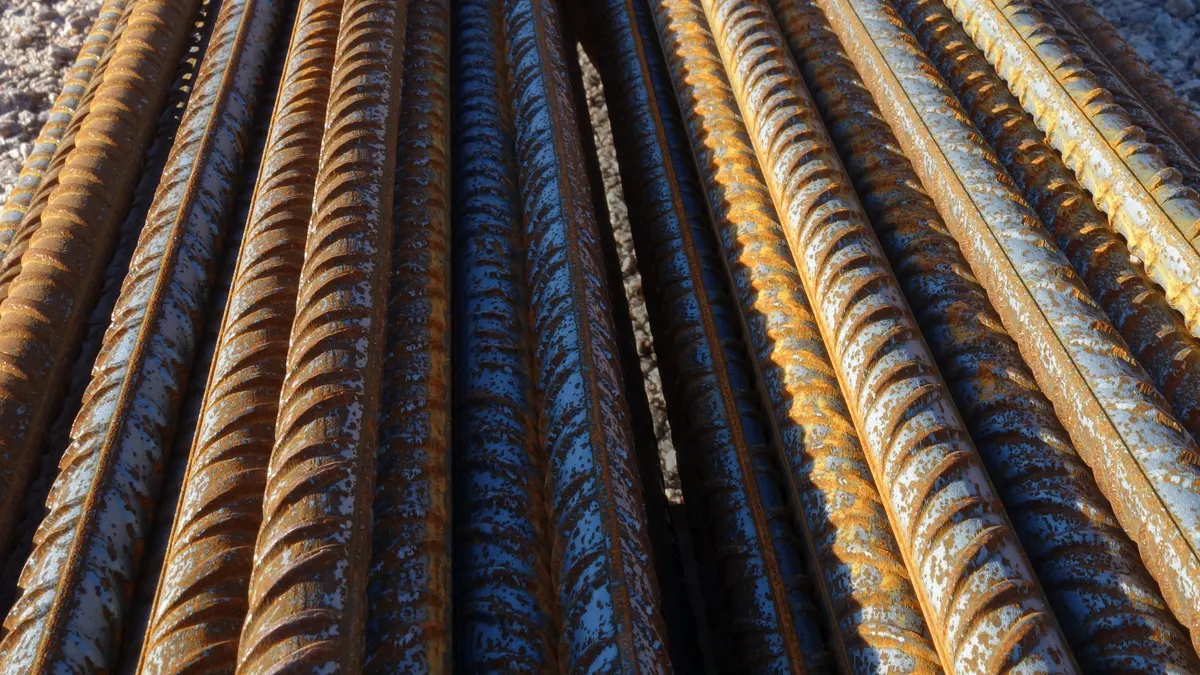
- Ribbed or deformed reinforcing bar (code BjTS): a round bar with ribs or deformations on its surface.
This surface difference has a big effect on how well the bar bonds to concrete. Deformed bars lock into the concrete through their ribs, so forces transfer from the concrete to the steel more effectively. Plain bars rely more on surface adhesion and friction, which is why their ends are usually bent into hooks so they anchor firmly in the concrete.
When to use 8, 10, and 12 mm bars
Anakjuragan sells Besi Beton Polos 8 mm, Besi Beton Ulir 10 mm, and Besi Beton Ulir 12 mm, all 12 meters long. In simple residential construction, their roles are generally divided like this:
- 8 mm plain bar: commonly used for stirrups or ties, the square rings that hold the main bars in ground beams, small columns, and ring beams.
- 10 mm deformed bar: often used as main reinforcement for ground beams and small columns in single-storey houses, and for slab reinforcement over short spans.
- 12 mm deformed bar: used where loads are higher, such as main columns, beams, or buildings planned to have more than one storey.
The list above is only a general picture. The correct number of bars, diameter, and stirrup spacing must follow the working drawings and structural calculations, because they depend on span, load, soil conditions, and the planned number of floors. For multi-storey houses or concrete slabs, ask a structural engineer for the calculations.
Related products in storeCheck the latest price and stock from this article. See productsHow to check bar quality when buying
On site there is a term, besi banci, for bars whose diameter is smaller than the stated size. The easiest way to check is by weight. The nominal weight of a reinforcing bar can be calculated as 0.00617 times the diameter squared (in millimeters), giving kilograms per meter. Using this formula, the approximate weight of a 12-meter bar is:
- 8 mm bar: about 0.395 kg per meter, or roughly 4.7 kg per bar.
- 10 mm bar: about 0.617 kg per meter, or roughly 7.4 kg per bar.
- 12 mm bar: about 0.888 kg per meter, or roughly 10.7 kg per bar.
The standard allows tolerances for weight and size, so a small difference is normal. But if a bar weighs far less than the figures above, it is probably smaller than its nominal size. Also check for SNI marking and the manufacturer's identity on the bar or its label, make sure the surface does not have heavy, flaking rust, and that the bar is not badly bent.
What tie wire is for
Tie wire is soft steel wire used to tie bars where they meet, for example between stirrups and main bars, or where bars cross in a slab. Its job is to keep the steel in position so it does not shift while concrete is poured and compacted. Tie wire does not add strength to a splice, so joining two bars still requires an adequate lap length as directed by a structural engineer.
- Cut a suitable length of tie wire, roughly enough to wrap twice around the tie point.
- Wrap it crosswise where the two bars meet, then twist the ends tight with pliers.
- Bend the leftover ends inward so they do not stick out of the concrete cover.
- Make sure the steel cage sits on spacers or concrete blocks so there is concrete cover below and beside the bars.
Storing rebar and working safely
Store steel bars on timber blocks so they do not touch the ground, and cover them with a tarpaulin if the pour is still some time away. Light surface rust is generally not a problem, but heavy flaking rust reduces the bar's cross-section and should be cleaned off or avoided.
In short, deformed bars are used as main reinforcement because they bond better, while small plain bars are widely used for stirrups. Check the weight and SNI marking when buying, tie the cage with tie wire, and follow the structural drawings. Check the latest prices for reinforcing bars and tie wire at Anakjuragan.
FAQ
Can plain bars be used as main reinforcement?
For houses today, main reinforcement generally uses deformed bars because they bond better to concrete. Plain bars should only be used as main reinforcement if the working drawings and a structural engineer's calculations call for it.
How can I tell the bars I bought are not undersized?
Weigh one bar and compare it with the nominal weight: about 4.7 kg for 8 mm, 7.4 kg for 10 mm, and 10.7 kg for 12 mm per 12-meter bar. A weight far below these figures suggests a smaller diameter. Also check the SNI marking.
How much tie wire do I need?
There is no fixed figure, because it depends on the number of tie points, stirrup spacing, and how the builder ties. Many builders estimate from the amount of steel; it is safer to prepare a little extra and add more if needed.